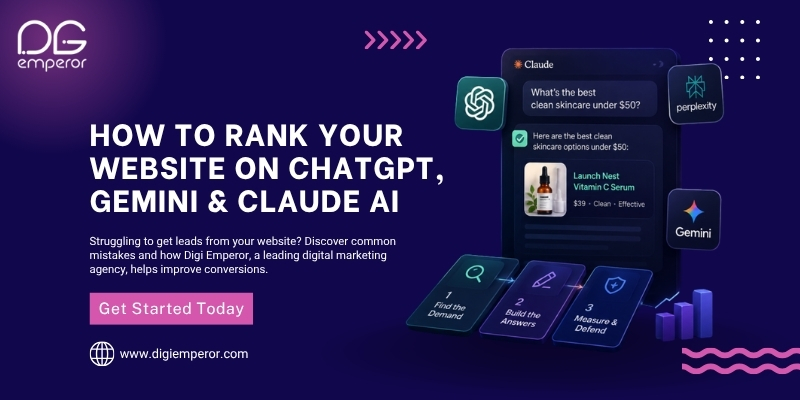
To understand how to rank on ChatGPT, make your website crawlable, publish specific and verifiable answers, build brand authority across trusted sources, and measure citations across repeatable prompts. The same foundation also improves visibility in Gemini, Claude and Google’s AI search features.
A business does not receive one permanent position in ChatGPT, Gemini or Claude. Each platform can generate a different response depending on the prompt, location, freshness of available information, user context and sources retrieved at that moment.
That changes the objective. The practical question is not only how to rank on ChatGPT, but how to become a reliable source that AI systems can discover, understand, verify, mention and cite when a potential customer asks a commercially relevant question.
For a Mumbai real estate company, that question might be, “Which developer offers 2 BHK projects near the upcoming metro corridor?” For a jewellery store, it may be, “Where can I buy certified 22-carat bridal jewellery in Navi Mumbai?” This guide explains how to build the technical, content and authority signals required to compete for those answers.
How to Rank on ChatGPT: What Does AI Visibility Mean?
Ranking on an AI platform means appearing as a relevant brand, recommendation or cited source for a repeatable group of prompts. Unlike a conventional keyword position, AI visibility changes by platform, wording, user context, location, evidence and the model generating the response.
A traditional rank tracker may report that a page is position three for a keyword. AI assistants usually do not expose a comparable ordered list. They can answer directly, mention several brands, show related links, cite one passage or omit website links entirely.
That creates four distinct outcomes:
- Your brand is mentioned: the answer names your business but does not link to it.
- Your website is cited: a page is presented as a supporting source.
- Your information is used: the response reflects facts from your content, although attribution may not be obvious.
- Your brand is recommended: the assistant includes your business in a shortlist or buying decision.
A mention can build awareness, but a citation is easier to validate. A recommendation can influence demand, but it may also be inaccurate. Your measurement system should therefore separate mentions, linked citations, factual accuracy and commercial actions.
How the Three Platforms Differ
| Platform | How Web Visibility Commonly Appears | Important Access Consideration | Practical Measurement |
| ChatGPT | Linked sources, search results, brand mentions and generated recommendations | Allow OAI-SearchBot for ChatGPT search discovery | Track prompt mentions, cited URLs and utm_source=chatgpt.com referrals |
| Gemini | Related sources, Search-grounded responses and Deep Research references | Maintain strong Google indexing and accessible source pages | Test Gemini prompts and compare cited domains with Google Search visibility |
| Claude | User-directed web retrieval, search-result sources and generated recommendations | Allow Claude-User and Claude-SearchBot when visibility is desired | Track citations, brand descriptions and source consistency across Claude prompts |
| Google AI features | Supporting links in AI Overviews and AI Mode | Pages must be indexed and eligible for a Google Search snippet | Use Search Console plus controlled prompt and SERP observations |
The correct goal is not “rank number one everywhere”. It is to increase the percentage of relevant prompts for which your business is accurately represented by a trusted, useful source.
How Do ChatGPT, Gemini and Claude Find Website Content?
ChatGPT, Gemini and Claude combine model knowledge with retrieved web information in different ways. They may search multiple subtopics, compare owned and third-party sources, extract a useful passage and generate an answer whose citations vary with the prompt, platform and available evidence.
How ChatGPT Discovers Public Websites
According to OpenAI’s publisher guidance, any public website can appear in ChatGPT search, but publishers should allow OAI-SearchBot when they want content discovered, summarised and clearly cited. OpenAI also distinguishes this search crawler from GPTBot, which is associated with potential model training.
This distinction matters. ChatGPT SEO is not the same as allowing every OpenAI crawler. A site owner may permit search discovery while restricting future training, whereas blocking every user agent without understanding its purpose can reduce visibility unnecessarily.
OpenAI also states that ChatGPT referral URLs include utm_source=chatgpt.com. This gives businesses a practical way to identify some visits from ChatGPT in analytics, although many brand impressions will still occur without a click.
How Gemini Uses Search-Connected Information
According to Google’s Gemini sources guidance, some Gemini responses display related sources or direct links when web material supports the answer. For teams asking how to rank in Gemini, strong Google indexing and verifiable source pages are therefore practical priorities.
Google’s separate guidance for AI Overviews and AI Mode is also relevant because it describes a “query fan-out” process. One complex question can trigger multiple related searches across subtopics before supporting pages are selected. A page can therefore earn visibility for a narrow supporting fact even when it is not the obvious result for the original wording.
How Claude Accesses Web Content
According to Anthropic’s crawler guidance, Claude-User retrieves pages for user-initiated requests, while Claude-SearchBot indexes content to improve search-result relevance. ClaudeBot is separately used for content that may contribute to model development.
For anyone researching how to rank in Claude, review these agents independently. Blocking Claude-User can prevent retrieval during a user’s question, while blocking Claude-SearchBot can reduce search indexing. The best policy depends on your organisation’s legal, privacy and publishing preferences.
What Technical Work Helps a Website Become Eligible?
Technical eligibility starts with pages that crawlers can access, search systems can index and users can read without broken rendering. Review robots directives, status codes, canonical tags, internal links, server protections, mobile usability, speed and whether essential information exists in accessible text.
A beautiful website can remain invisible when its important content is blocked, duplicated or dependent on scripts that fail. Before creating more AI-focused articles, complete the following technical checks.
Eight Technical Actions for AI Search Eligibility
- Audit robots.txt for named AI agents: review OAI-SearchBot, Claude-User and Claude-SearchBot separately because training, search indexing and user-directed retrieval are different functions.
- Return a clean 200 status for priority pages: redirects, soft 404s, access-denied responses and intermittent server errors make retrieval unreliable and can cause AI systems to choose a more dependable source.
- Keep one canonical URL for each topic: conflicting canonicals, duplicated parameters and multiple versions of the same page divide signals and create uncertainty about which source should be cited.
- Place essential information in readable HTML: headings, prices, specifications, service areas and policies should not depend solely on images, tabs or client-side scripts that a crawler may not process consistently.
- Link priority pages from relevant website sections: contextual internal links help crawlers discover the page and explain its relationship to broader services, products, locations and supporting evidence.
- Maintain accurate XML sitemaps and update dates: sitemaps help search systems find important URLs, while honest modified dates help distinguish a meaningful refresh from a cosmetic timestamp change.
- Match structured data to visible content: Article, Organisation, LocalBusiness, Product, Service and Breadcrumb markup can clarify entities, but inaccurate or invisible schema creates contradictions instead of authority.
- Test CDN and firewall rules using real logs: security systems may allow Googlebot while silently challenging AI crawlers, so inspect server responses rather than assuming a robots.txt rule guarantees access.
Example Robots Controls
The following example allows search-oriented OpenAI and Anthropic crawlers while blocking model-training crawlers. It is only an illustrative configuration; legal and publishing teams should approve the final policy.
User-agent: OAI-SearchBot
Allow: /
User-agent: GPTBot
Disallow: /
User-agent: Claude-User
Allow: /
User-agent: Claude-SearchBot
Allow: /
User-agent: ClaudeBot
Disallow: /
According to Google’s AI features guidance, no special AI file or unique schema is required for AI Overviews or AI Mode. Pages must be indexed, eligible to show a snippet and supported by the same technical SEO fundamentals used for Google Search.
Businesses that need help diagnosing crawling, rendering and canonical problems should begin with a technical SEO audit rather than publishing more pages on an unstable foundation.
What Type of Content Is Most Likely to Be Cited?
Citation-worthy content answers a specific question clearly, supports the answer with verifiable evidence and adds information that competing summaries cannot reproduce easily. Strong pages combine direct definitions, expert interpretation, original examples, transparent limitations, descriptive tables and a named author with relevant experience.
Generic content is easy to summarise and easy to replace. An article that merely says “create quality content, use keywords and build backlinks” gives an AI system no compelling reason to cite that particular page.
Use an Answer-First Structure
Begin each important section with a concise answer, then add context, exceptions and examples. This gives a reader an immediate response while preserving the depth required to judge accuracy.
For example, a weak jewellery article says, “Choosing a diamond can be confusing.” A stronger section opens with a direct explanation of how cut, colour, clarity and carat affect appearance and budget, then demonstrates the trade-off with two realistic buying scenarios.
Publish Information Gain
Information gain is the useful value your page adds beyond existing sources. It can come from:
- original research or anonymised customer data;
- a practitioner’s tested workflow;
- calculations and decision criteria;
- first-party product specifications;
- local pricing factors and regulations;
- before-and-after examples with permission;
- common failure patterns observed in real work;
- transparent comparisons, including where your service is not the best fit.
A Mumbai performance agency could publish an anonymised breakdown showing how lead quality changed after separating branded and non-branded campaigns. A real estate consultant could explain how ready-reckoner rates, registration costs and possession status affect a buyer’s total budget. The evidence should be real, reviewable and clearly scoped.
Build a Complete Topic System
One page rarely answers every stage of a buying journey. Use a central guide supported by focused pages covering definitions, comparisons, costs, implementation, mistakes, case evidence and local applications.
This is where generative engine optimisation overlaps with good content architecture. The objective is not to manufacture hundreds of prompt pages. It is to build a coherent information system in which each subtopic has one strong home.
The CLEAR Citation Framework
The following original framework can be used to review any page before publication.
| CLEAR Element | Question to Ask | Evidence of Readiness |
| C – Crawlable | Can search and AI agents access the final page reliably? | Clean status, indexable canonical, visible HTML and internal links |
| L – Legible | Can a human and retrieval system understand the answer quickly? | Descriptive headings, direct answers, tables and unambiguous terminology |
| E – Evidenced | Are important claims supported by proof? | Named sources, data, examples, methodology and honest limitations |
| A – Authoritative | Why should this organisation or author be trusted? | Credentials, reviews, relevant mentions, case work and consistent entities |
| R – Repeatable | Can visibility and accuracy be tested over time? | Stable prompt set, citation logs, analytics and scheduled content reviews |
A page with four strong elements and one weak element still has a clear next action. For example, an authoritative business with excellent case studies may fail because the evidence is hidden in PDFs and image carousels. Making the information legible and crawlable can unlock more value than publishing another broad blog.
How Can Off-Site Authority Improve AI Visibility?
Off-site authority helps AI systems verify that your website’s claims are not self-declared. Relevant editorial mentions, customer reviews, professional profiles, industry directories, partnerships, citations and independent discussions create corroboration that can strengthen brand recognition and recommendation confidence across multiple search environments.
Your own website will naturally describe the business positively. Third-party evidence helps answer harder questions: Is the company active? Is its location accurate? Do customers recognise the service? Are its experts referenced elsewhere? Does the market associate the brand with the claimed topic?
Prioritise Corroboration, Not Repetition
Repeating the same claim across dozens of low-quality profiles is not the same as authority. Focus on sources that a customer would genuinely use:
- industry associations and specialist directories;
- reputable local or trade publications;
- customer review platforms relevant to the market;
- partner and supplier websites;
- podcasts, webinars and event pages;
- expert contributions on established publications;
- case studies hosted by technology or service partners;
- useful community discussions where participation is transparent.
For a Navi Mumbai clinic, consistent practitioner credentials, location information, medical directory profiles and patient-review platforms may matter more than generic guest posts. For an ecommerce brand, product reviews, retailer citations, comparison articles and creator demonstrations may provide stronger corroboration.
A credible off-page SEO strategy should earn visibility by contributing evidence and expertise. Avoid creating fake reviews, undisclosed listicles or manipulated community posts designed only to influence AI recommendations.
How Should Mumbai Businesses Apply AI Search Optimisation?
Mumbai businesses should combine clear local entities with nationally useful expertise. Publish accurate addresses, service areas, pricing factors, credentials, policies and local examples, then support them with Google Business Profile data, reviews, regional citations and content that answers real buying questions.
Local relevance is not created by inserting “Mumbai” into every paragraph. It comes from useful details that change the customer’s decision.
Real Estate Companies
Create project and locality pages that distinguish possession status, RERA information, configuration, connectivity, total-cost factors and buyer suitability. Add comparison pages that explain trade-offs between areas such as Thane, Kharghar, Panvel and Dombivli without pretending one location is best for everyone.
Jewellery Stores
Publish purity, hallmarking, certification, making-charge and after-sales information in plain language. Show the difference between daily-wear, bridal and investment-led purchases. Original photographs, transparent specifications and store-location details provide stronger evidence than generic jewellery trend blogs.
Ecommerce Brands
Maintain accurate product data, availability, delivery areas, returns, dimensions and comparison information. Category pages should help buyers choose, while product pages should contain unique specifications and use cases. A structured ecommerce SEO strategy strengthens both Google discovery and the product evidence available to AI systems.
Local Service Providers
Answer practical questions about areas served, response times, appointment steps, inclusions, exclusions, licences and pricing factors. Keep those facts consistent across the website and business listings. Digi Emperor’s local SEO and Google Business Profile services can support the entity consistency required for local discovery.
B2B and Professional Firms
Publish named expertise, service methodology, sector experience, decision frameworks and anonymised case evidence. A procurement manager needs more than a list of services; they need to understand scope, risk, timelines, responsibilities and how success is measured.
How Can You Measure AI Search Visibility Accurately?
Measure AI visibility with a fixed prompt set, separate platform tests, citation records, brand-accuracy checks, referral data and conversion reporting. Run prompts consistently by location and account state, then analyse trends instead of treating one favourable answer as a permanent ranking achievement.
Start with 20–50 prompts tied to real customer decisions. Include informational, comparison, recommendation, local and branded questions. Test them independently in ChatGPT, Gemini and Claude because the same prompt can produce different brands and sources.
AI Visibility Measurement Table
| Measurement | What to Record | Recommended Frequency | Business Meaning |
| Brand mention rate | Percentage of tracked prompts mentioning the business | Monthly | Measures general awareness inside generated answers |
| Citation rate | Percentage of prompts linking to the website | Monthly | Shows whether owned content is being used as a source |
| Source-page distribution | Which URLs receive citations | Monthly | Reveals the pages and formats AI systems retrieve |
| Recommendation share | Presence among shortlisted brands | Monthly | Indicates influence in consideration-stage prompts |
| Factual accuracy | Correctness of services, prices, location and credentials | Monthly | Identifies reputation and entity risks |
| Sentiment and positioning | How the brand is described relative to competitors | Monthly or quarterly | Shows whether visibility supports the desired market position |
| ChatGPT referrals | Sessions containing ChatGPT referral attribution | Monthly | Captures some click-through traffic from ChatGPT search |
| Leads and assisted conversions | Enquiries influenced by organic or AI discovery | Monthly or quarterly | Connects visibility with commercial outcomes |
| Technical access logs | Successful and blocked crawler requests | Weekly or monthly | Detects access problems before visibility declines |
According to OpenAI, ChatGPT includes utm_source=chatgpt.com in referral URLs from search results, making those visits identifiable in analytics. Google currently includes traffic from AI Overviews and AI Mode within the overall Web search reporting in Search Console rather than a separate AI filter.
Do not use referral traffic as the only measure. A customer may learn your brand from an AI answer, search your name later and convert through organic, direct or paid traffic. Add a “How did you hear about us?” field or sales-call note to capture this influence.
What Should a 90-Day AI Visibility Plan Include?
A 90-day plan should fix technical access first, improve priority pages second and build corroboration third. Measurement begins before changes so the business can compare outcomes. Each phase should focus on commercially important prompts rather than chasing every question users might ask.
Days 1–30: Establish Access and Baselines
- Select 20–50 commercial prompts by intent: use customer questions, Search Console queries, sales calls and competitor comparisons so tracking reflects real demand rather than vanity prompts.
- Test each prompt across three platforms: record mentions, citations, source pages, factual accuracy and competitor presence to create a baseline before optimisation begins.
- Audit robots, status codes and rendering: confirm OpenAI and Anthropic search agents can access approved pages and verify that Google can index those pages with visible text.
- Map one page to each primary intent: identify overlap, thin pages and missing decisions so the site does not create multiple competing answers for the same topic.
Days 31–60: Improve Evidence and Extractability
- Rewrite priority sections with direct answers: place a 35–42 word answer under each important heading, then add examples, evidence, exceptions and a clear next step.
- Add one original asset to each priority page: publish a comparison table, framework, calculation, case example, checklist or first-party dataset that gives the page a reason to be referenced.
- Strengthen authorship and entity pages: add named experts, credentials, editorial review, contact details, service areas and consistent organisation information.
- Implement accurate structured data: match Article, Breadcrumb, Organisation, LocalBusiness, Product or Service markup with visible content and validated URLs.
Days 61–90: Build Corroboration and Review Results
- Earn relevant third-party references: contribute expert insight, partner content, customer-approved case studies and credible local or industry citations instead of buying bulk mentions.
- Retest the original prompt set: compare visibility, citations, accuracy and source-page changes without replacing weak prompts simply because results remain unfavourable.
- Connect AI visibility with leads: review referral data, branded searches, enquiry sources and assisted conversions to identify which prompts and pages influence revenue.
- Set the next quarterly priorities: expand successful topic clusters, refresh weak evidence and resolve inaccurate brand descriptions revealed during monitoring.
A repeatable plan for how to rank on ChatGPT requires coordination across technical SEO, content, digital PR and reporting. Companies without an internal search team may use specialist AI SEO services rather than treating AI visibility as an isolated writing task.
How Much Does AI Search Optimisation Cost in Mumbai?
AI search optimization costs in Mumbai depend on website size, technical debt, competition, content volume, authority and measurement. A focused audit may cost tens of thousands of rupees, while ongoing programmes can require ₹50,000 to ₹2,50,000 or more monthly.
These are illustrative planning ranges, not fixed market rates or a Digi Emperor quotation:
| Scope | Illustrative Investment | Typical Inclusions |
| Technical and AI visibility audit | ₹25,000–₹75,000 one time | Crawler review, indexation, prompt baseline, citation audit and priority roadmap |
| Small local business programme | ₹50,000–₹1,00,000 monthly | Technical maintenance, local entities, priority content, reviews and basic monitoring |
| Competitive lead-generation or ecommerce programme | ₹1,00,000–₹2,50,000 monthly | Content systems, technical work, digital PR, product or service optimisation and platform tracking |
| National or complex multi-market programme | ₹2,50,000+ monthly | Cross-functional SEO, research, engineering, digital PR, analytics and large-scale governance |
The cheapest option is not always the smallest quote. A ₹20,000 content package that publishes interchangeable articles can create duplication without improving citations or leads. A focused audit that fixes access, identifies the right pages and prevents wasted production may deliver greater value.
Choose an SEO agency that can explain dependencies, show how claims will be validated and connect AI visibility with business results. No provider can guarantee a permanent recommendation in ChatGPT, Gemini or Claude because responses depend on systems the provider does not control.
What Mistakes Prevent Websites From Appearing in AI Answers?
Websites lose AI visibility when crawlers cannot access them, facts are ambiguous, content repeats competitors, brand information conflicts across sources or measurement relies on isolated screenshots. Shortcuts such as keyword stuffing, fake reviews and mass-produced prompt pages create risk rather than authority.
Blocking Search Crawlers Accidentally
A blanket rule written to stop model training may also prevent search indexing or user-directed retrieval. Review each user agent and confirm actual server responses in logs.
Assuming Schema Guarantees a Citation
Structured data can clarify entities and page types, but it cannot make weak information authoritative. Google explicitly says no special schema is required for its AI features, and markup should match visible page content.
Publishing Generic AI-Written Articles
Unreviewed summaries often repeat the same advice already available on stronger domains. Use AI tools for research support and drafting assistance, but add expert review, original information and accountability before publication.
Creating a Page for Every Prompt Variation
“How to rank in AI”, “how to appear in AI” and “how to get cited by AI” may belong to one comprehensive guide. Splitting them into thin pages can dilute internal authority and confuse the site’s topic structure.
Manipulating Third-Party Mentions
Fake profiles, undisclosed “best company” articles and fabricated customer discussions can damage trust. Earn corroboration through useful contributions, real customers, genuine partnerships and transparent editorial work.
Measuring Only Clicks
AI answers can influence a shortlist without producing an immediate website visit. Track citations and referrals, but also monitor branded searches, enquiry sources, sales conversations and assisted conversions.
Conclusion: Build Evidence That AI Systems Can Trust
Learning how to rank on ChatGPT means making your business easier to discover, verify and recommend. Build an accessible website, publish specific first-hand evidence, strengthen trusted third-party references and monitor visibility across ChatGPT, Gemini and Claude with a stable prompt set.
To rank websites in AI search experiences consistently, treat AI visibility as an extension of serious SEO rather than a shortcut around it. Digi Emperor helps Mumbai, Navi Mumbai and Indian businesses improve technical foundations, content authority and measurable organic growth through an integrated search strategy.
Faq's
Does an llms.txt File Improve AI Rankings?
No, an llms.txt file does not guarantee discovery, citations or recommendations. Google states that no new AI text file is required for its AI search features, while OpenAI and Anthropic publish robots-based crawler controls. Use llms.txt only as an optional experiment, not as a replacement for crawlability and authoritative content.
Can a New Website Appear in ChatGPT or Gemini Answers?
Yes, but a new website normally has fewer independent trust signals and less historical visibility. Start with technically accessible service or product pages, clear entity information and genuinely useful specialist content. Early citations may come from narrow factual queries before the brand appears in broad “best company” recommendation prompts.
Do Backlinks Still Matter for AI Search Visibility?
Yes, but relevance and corroboration matter more than raw link volume. A credible editorial mention can help systems connect a brand with a topic even when the link is nofollowed or absent. Prioritise sources that customers trust, and avoid bulk links from unrelated websites that add no factual validation.
Should You Block Training Bots but Allow Search Bots?
Yes, when that policy matches your organisation’s legal and publishing preferences. OpenAI and Anthropic identify separate agents for training, search indexing and user-directed retrieval, allowing more granular controls. Document the decision, configure every subdomain consistently and verify through logs that approved search agents receive successful responses.
Can AI-Generated Content Be Cited by AI Platforms?
Yes, provided the published page is accurate, useful and accountable. The problem is not the drafting tool; it is unverified, repetitive content with no original evidence. A named expert should review claims, add first-hand value, correct errors and accept editorial responsibility before the page is published.
Does FAQ Schema Help a Website Rank in ChatGPT?
No, FAQ schema alone cannot produce a ChatGPT citation. Use an FAQ only when it answers genuine questions not already covered in the article, and keep the markup identical to the visible text. Clear content, technical access, evidence and authority remain more important than adding one schema type.